All Zimbos are invited to post to mufarostig@yahoo.co.uk (Its well and fine using a fictitious profile!). We will post it for you. Some misguided elements were posting rubbish and that's why the direct posting has been removed! Be assured your posting is being read at the highest places!


UK Web Hosting

Snap Shots

Get Free Shots from Snap.com
Zimbabwean women want Dignity.Period!
Monitor page
for changes
    
   it's private  

by ChangeDetection

Map IP Address
Powered byIP2Location.com

MP3 music download website, eMusic
Why Join?
eMusic 25 free downloads
Start your free trial

Start downloading your FREE MP3s today and take two weeks to decide if you like eMusic. If you're not 100% satisfied simply cancel before your trial period ends and you'll never pay a dime. Keep the 25 FREE MP3s as a gift just for checking out eMusic.

Start your free trial
Click here to unsubscribe Privacy Policy | Terms of Use

© 2006 eMusic.com, Inc. All rights reserved. iPod® is a registered trademark of Apple Computer, Inc. Apple is not a partner or sponsor of eMusic.com, Inc.

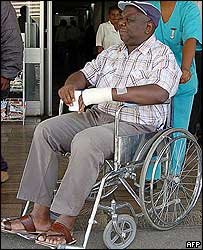
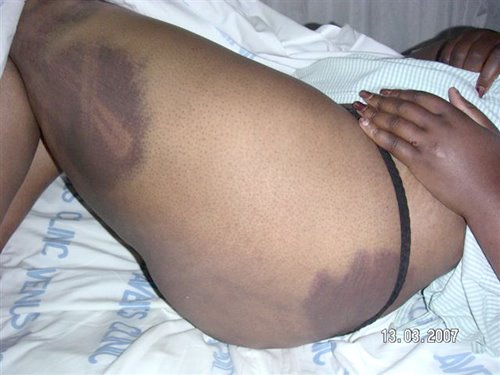
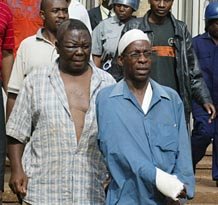
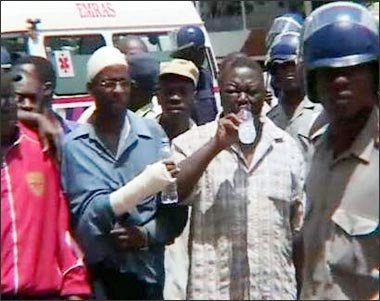
RADICAL'S REPORT OF COSATU DEMO OF 3 MARCH,2007!

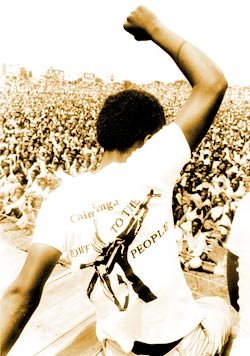
"FROM LIBERATION.........."

"FROM LIBERATION.........."
"What great expectations!"

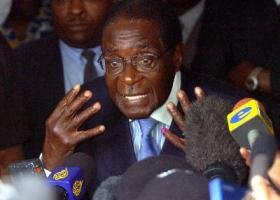
"....THEN CAME THE DICTATOR......"

"....THEN CAME THE DICTATOR......"
"We have degrees in violence!"

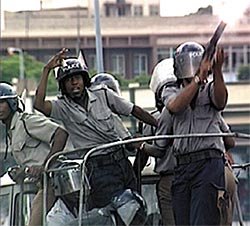
"...THEN REAL REPRESSION!"

"...THEN REAL REPRESSION!"
"I told the Police to really bash him hard!"

gostats

technorati link

Add to Technorati Favorites

technorati

About Me

My photo
Cape Town, Western Cape, South Africa
I look for "The truth, the whole truth, and nothing but the truth" at all times.

Friday, April 20, 2007

THABO MBEKI WARNED BY BROTHER OVER ZIMBABWE!

Mbeki's brother warns on Zimbabwe 


SA's political elite is an obstacle in the quest to save Zimbabwe from collapsing, political analyst Moeletsi Mbeki says.
"Only poor people will be affected by Zimbabwe's collapse," he said in an Africa Dialogue lecture in Pretoria.
Mbeki criticised the approach of his brother, President Thabo Mbeki, of quiet diplomacy: "It's a do-nothing scenario. However, you appear to be doing a lot."
Moeletsi Mbeki, who sits on boards of various organisations, said the national interest of South Africans, as opposed to that of the elite, was to see Zimbabwe's economy restored and its people employed, well fed and well housed.
Despite the president's quiet diplomacy, SA faced pressure from the west and most South Africans over Zimbabwe.
"They (western countries) are sensitive to abuse of human rights as they helped fight apartheid, and the people of SA want the government to do something on the human rights issues," Mbeki said.
Asked what advice he would give his brother in handling the Zimbabwe issue, he said: "I think the South African government needs to show a lot more energy in dissuading Zanu (PF) from brutalising the opposition. We need to send a message across to Zanu (PF) that an opposition has a right to exist and has the right to participate in activities." Sapa


Yahoo! Answers - Got a question? Someone out there knows the answer. Try it now.

COSATU PROTESTS AT ZIM BORDER!

COSATU protests at Zimbabwe border!
 
http://www.citizen.co.za/index/article.aspx?pDesc=37055,1,22
 
JOHANNESBURG – Several hundred South Africans picketed at the Zimbabwe border to show solidarity for Zimbabwe's struggle for democracy and human rights, the Congress of South African Trade Unions (Cosatu) said on Thursday.
Cosatu's Limpopo provincial secretary Jan Tsiane said the protesters from the unions and members of the SA National Civic Organisation and the Limpopo Young Communist League gathered at the Beitbridge border post between South Africa and Zimbabwe on Thursday.
Cosatu is backing the Zimbabwean Congress of Trade Unions' demand for minimum wages and salaries linked to the poverty datum line (PDL), reduction of income tax to a 30 percent maximum, no tax for workers earning below the PDL, free access to antiretrovirals, stabilised pricing on basic commodities, and a stop to state harassment of informal economy workers.
Tsiane said the gathering was also calling for open dialogue between all political formations and civil society in Zimbabwe, aimed in particular at a new constitution ahead of democratic elections next year.
"The constitution must allow for the passage of a new electoral law based on the SADC ŠSouthern African Development CommunityÆ protocols on the conduct of free and fair elections," said Tsiane.
A conducive climate for elections, free of state violence and repression also need to be created, he said,
"We urge President ŠThaboÆ Mbeki, on behalf of SADC, to vigorously pursue these objectives," said Tsiane. –Sapa


Yahoo! Mail is the world's favourite email. Don't settle for less, sign up for your free account today.

MBEKI LAYS "GROUNDWORK" FOR STABILIZING ZIMBABWE!

South Africa's Mbeki Lays Groundwork for Stabilizing Zimbabwe


19 April 2007
 
Last month, Southern African leaders appointed South African President Thabo Mbeki their mediator to facilitate talks between Zimbabwean President Robert Mugabe and opposition groups in his country.  The goal is to end the political crisis in Zimbabwe, prepare for free and fair elections as early as next year, and lay the groundwork for an economic recovery program.  In this report from our southern Africa bureau in Johannesburg, VOA's Delia Robertson takes a closer look at how the facilitation might work and what its chances of success are.
Thabo Mbeki, 11 Apr 2007
Zimbabweans wondering what President Mbeki has in mind for negotiations in their country need look no further than South Africa itself.  The blueprint Mr. Mbeki will be working from is the one that brought an end to apartheid in South Africa.
But Mr. Mbeki will not be seeking to impose the same final model on Zimbabwe that South Africans chose.  Rather he will be asking them to use similar methods.  This means having talks with as wide a range of interest groups as possible, each with an equal standing, discussing and debating, giving and taking, until consensus is reached.
Zimbabwe's leader of the Movement for Democratic Change (MDC), Morgan Tsvangirai, argues with a policeman after being refused to hold a rally in Harare, 18 Feb 2007 <br />
Zimbabwe's leader of the Movement for Democratic Change (MDC), Morgan Tsvangirai, argues with a policeman after being told he could not hold a rally in Harare, 18 Feb 2007
Already Mr. Mbeki has asked the two factions of the opposition Movement for Democratic Change (MDC) for proposals, including on constitutional reform and on requirements for the holding of free and fair elections.  And Tomaz Augusto Salomão, the executive secretary of the Southern Africa Development Community (SADC), has begun an audit of the Zimbabwe economy to determine what will be needed to kick-start its recovery.
But Chris Landsberg, director of Johannesburg's Center for Policy Studies, says that looming large over all Mr. Mbeki's plans is President Robert Mugabe, who he says has, on four previous occasions, obstructed regional initiatives to end the crisis in Zimbabwe.
"But since 2000 SADC in general - South Africa in particular tried to do something - they have consistently offered something since 2001, they have offered something in 2002, 2003 - we know about the significant offer in 2005 where South Africa even offered a loan package as much as $1 billion in exchange for political concessions," he said.
Mr. Mbeki has set himself a tight timeline.  He would like an agreement between the parties early enough to allow adequate preparations for an election next March that will be viewed as free and fair not only by all the parties in Zimbabwe and by Southern African leaders, but also by the international community.  Landsberg warns that Mr. Mugabe is likely to resist for as long as possible.
Zimbabwean President Robert Mugabe addresses party supporters at his head office in Harare, 30 Mar 2007
Zimbabwean President Robert Mugabe addresses party supporters in Harare, 30 Mar 2007
"I think what we are likely to see between now and next year's proposed election, we are going to have Mugabe dragging out the Mbeki facilitation as much as possible," he added.  "In other words, he is going to posture, he going to play games, he is going to be too busy, he is only going to show urgency to meet Mbeki and to formally participate at a time when he will say it is too late to have the facilitation and to have elections.  One of the things must give.  So he'll make a convincing case for the postponement of the elections."
Landsberg argues that Mr. Mugabe will likely want to postpone elections until 2010, the latest possible date they could be held under the current constitution.  He says that this will enable Mr. Mugabe to delay identifying his successor, because, he says, once this happens, Mr. Mugabe will lose whatever control he has left within ZANU-PF, his own party.
"At some point he is going to anoint a successor," he explained.  "And, of course, he is going to go for somebody who is likely to be seen by him as a puppet.  And instead of that power working in his favor, people will then say this is it, he is now weakened, then they will really push him out."
But other experts, such as Chris Maroleng of the Institute for Security Studies in Pretoria, say that the confluence of events in Zimbabwe and the region in recent months may be enough to propel Mr. Mugabe to fall into line on the timeline set by southern Africa leaders for completion of the mediation. 
Maroleng argues that the octogenarian leader has never before had such poor support within his own party.  Also that he has never previously had to face a united opposition from southern Africa leaders, as he did last month in Dar Es Salaam.
"If he yet again scuttles such an opportunity, this would create the impression in the region that he doesn't take his counterparts seriously," he explained.
Following the Dar Es Salaam meeting, the leaders issued a statement that expressed support for Mr. Mugabe and also called on western countries such as the United States and the United Kingdom to abandon so-called smart or targeted sanctions against Zimbabwe.  Maroleng says that it has become common knowledge that in the privacy of the meeting, Mr. Mugabe was subjected to severe criticism from the regional grouping.  He says their call for an end to sanctions was a device to prevent Mr. Mugabe from finding excuses to avoid or delay the mediation.
"The fact that they are distancing themselves from a western approach to regime change is a clear indication that the southern African development community is really preparing the groundwork for a mediation in Zimbabwe and closing any exit that Mugabe has taken where he has [in the past] consistently accused any mediator as puppets of the west or neo-colonial lackeys of the west," he said.
Like all previous initiatives, the current effort will likely include an offer that will allow Mr Mugabe to retire gracefully without the threat of being brought on charges before the International Criminal Court or even before Zimbabwe's own courts for crimes against humanity.
To satisfy Zimbabwe's opposition, Mr. Mbeki will have to find a way to ensure that pre-election campaigning and the elections themselves are overseen by an independent electoral commission supported by a peacekeeping body, such as the Peace Commission which operated in South Africa in 1994.  In addition, opposition groups also want the support of southern African and western observers.
Any agreement will also include an economic recovery program designed to kick-start Zimbabwe's ailing economy as quickly as possible.  That will require the support of the international community, particularly the industrialized nations, and Mr. Mbeki will be keenly aware that this support will not be forthcoming unless the agreement meets their criteria for free and fair elections.
 
Mr. Mbeki has appointed two seasoned South African facilitators who have already held several meetings with representatives of the two factions of Zimbabwe's Movement for Democratic Change and with representatives of some Zimbabwean civil society groups.
The facilitators will draw up a draft agreement, and when that is ready in the coming weeks, Mr. Mbeki will want to present it to Mr. Mugabe. It is at that point, that Zimbabweans and regional leaders will get their first indication of whether or not Mr. Mugabe intends to fully cooperate with the Southern Africa Development Community's mediator.


Yahoo! Mail is the world's favourite email. Don't settle for less, sign up for your free account today.

Monday, April 16, 2007

ZUMA SAYS MBEKI HAS TOO MUCH POWER!

 Mbeki has too much power - Zuma
    Sipho Khumalo
    April 16 2007 at 04:44AM
 
ANC Deputy President Jacob Zuma on Sunday warned against too much power being concentrated in the "state house" and the presidency, saying that was what had resulted in so many coups in Africa.

Addressing a packed gathering of Cosatu shop stewards in Durban on Sunday, Zuma urged ANC members to ensure that political power remained within the organisation and with the masses.

"The organisation (ANC) should not lose power and give too much power to the state house. We must carefully read what our documents (conference discussion documents) say about this critical issue.

"All I am saying is that this is the crucial year (ANC conference), when all decisions that we take will be important for long time to come. It is going to be critical what we do about this issue of concentration of power at the policy conference (in July)," said Zuma.


Mbeki now enjoys powers to appoint the cabinet
Zuma's warning about too much power being concentrated in the presidency comes at the time when there are concerns within the ANC-led tripartite alliance that too many powers are vested in the hand of President Thabo Mbeki.

These concerns intensified after Mbeki had released Zuma of his position as the deputy president of the country. Mbeki now enjoys powers to appoint the cabinet, heads of departments, premiers and municipal mayors.

The issue of presidential powers is set to come under scrutiny when the ANC conducts organisational review at its policy conference scheduled to take place in July, ahead of its all-important conference in December.

Zuma said the power should instead be retained by the organisation and (the ANC) should avoid transferring all power to the state.

"That (too much concentration of power in the state house) has been the main course of problems in Africa. When coups occur, there are no masses to defend the organisation and democracy," he said.

Cosatu's final position on leadership would be decided in September
Zuma said this had resulted in liberation movements dying.

As an example, Zuma said, an organisation that had put Ghanaian President Kwame Nkrumah in office was now dead because it had allowed all powers to be taken by the state.

He urged members of the ANC to make sure that their membership was in order ahead of the conference in December.

"This is the important technical question because even if people know that you have been a member of the ANC for 30 years, if your membership is not in proper order they will say that they do not know you," said Zuma, who vowed that he would not turn his back on the poor people.

Addressing the same gathering, Cosatu Secretary-General Zwelinzima Vavi rejected weekend reports that the federation had dropped Zuma as the ANC's presidential candidate.

It was reported that the worker federation was dropping Zuma for ANC Secretary-General Kgalema Motlanthe.

Vavi said the February Cosatu meeting had never discussed the issue of ANC positions, but had instead discussed the framework for choosing right leadership.

He said Cosatu's final position on leadership would be decided in September.

"Those who are spreading the rumour about the candidacy of Motlanthe are seeking to destroy his reputation.

"The real debate in Cosatu now is how to change the economic direction of the country. It is a debate between those who want to retain the status quo and those who want changes," said Vavi.

KwaZulu-Natal Cosatu Secretary Zeth Luzipho said there was no way Cosatu was going to drop Zuma as he was part of the workers.

"We are proud Zuma supporters because we are ANC members and Zuma is ANC Deputy President," said Luzipho.

    • This article was originally published on page 1 of The Mercury on April 16, 2007


Yahoo! Mail is the world's favourite email. Don't settle for less, sign up for your free account today.

Friday, April 13, 2007

Dear Mr Mbeki, (From Mr Bornwell Chakaodza!)

An open letter to President Mbeki and SADC leaders 
 
http://www.fingaz.co.zw/story.aspx?stid=2833
 
Core of SADC executive secretary's visit lies in getting fundamentals right


THE Southern African Development Community (SADC) extraordinary summit held recently in Dar es Salaam, Tanzania was not a failure after all.

As mandated by the 10 heads of state and government who attended that summit, the SADC executive secretary Tomaz Salamao is here in Zimbabwe to study the economic situation with a view to seeing how the region can assist the country to recover economically.
On the political front, the summit mandated President Thabo Mbeki of South Africa to mediate in the Zimbabwean crisis and he is reported to have already appointed a negotiating team to engage the ruling ZANU PF party and the opposition MDC in search of a lasting solution.
My open letter to President Mbeki and SADC leaders in their entirety and my message to SADC executive secretary, Tomaz Salamao, is that unless they get the political and economic fundamentals right, both missions are doomed to fail. Politics and the economy are intertwined here and there is no way the two can be separated. To me, this is the bottom line.
It is very important to identify issues really at stake in our present situation. There is no way Salamao can propose measures to assist in the economic recovery of the country in the absence of political normalisation. In my book, the two things are not even two sides of the same coin — they are firmly located on the same side of the one coin. That is how firmly inter-connected they are!
The point must be made that the source of Zimbabwe's economic crisis is the abnormal political environment that we have at the present moment. And the holistic solution that we are all seeking is one that is rooted in the acceptance of this simple fact. Anyone trying to navigate the murky waters of Zimbabwe must separate fact from fiction.
Blaming President George W Bush and Prime Minister Tony Blair as the root causes of our crisis as government spin-doctors are fond of doing and saying day in and day out is a mantra which has lost all meaning. The political leadership here is the author of our problems and it will equally be, by and large, the author of the solution that we are seeking.
I do not minimise the problems that President Mbeki and Salamao will face but all I am trying to do is to appeal to them to have a correct perspective, a correct interpretation of the issues in this country. Facing the truth and having a sense of perspective can free us of needless fears and give us hope and assurance for the future.
Nobody quarrelled with the need and the imperative of correcting a historical injustice as far as land reform is concerned. What people quarrelled with — Zimbabweans and non-Zimbabweans alike — was the methodology and the way the whole exercise was carried out. Things could have been done differently and certainly much better than the way they were done. But that is all now water under the bridge. The country must now move on. And this is the point that I am making here.
Looking back at past glories such as the war of liberation and the like does not add value in any way to looking forward, which is what is important at this stage. The challenge that President Mbeki and the SADC executive secretary face is to make sure that they do not sorely play to the beat of the propaganda machine emanating from government and the ruling party. It is important to listen to all sides including government, the opposition parties and Zimbabwean civil society as a whole.
There is a lot of dishonest journalism here particularly in the government-owned media. The issue here is not of regime change or anything like that. The issue is one of governance and the pressing need to have a political settlement which enables a government of a new Zimbabwe to be accepted both by its own people and the entire international community. And on both points, we have been failed by those currently in power.
Unless South Africa and the SADC regional bloc as a whole takes the lead in helping Zimbabweans find a solution, the whole world will be paralysed as in fact it is paralysed now. There is obviously a limit to what the UK, the USA and the EU can do in this regard, as in a number of ways, these countries have actually played into the hands of President Mugabe and the ruling party by their injudicious statements at times. And it is in this regard that the people of Zimbabwe to a very large extent welcome the two SADC initiatives as something that is bound to breathe the much needed new life into the country's economic and political conundrum.
What is important now is action on the part of SADC. Action based on talking to and listening to all Zimbabweans, not just the government and the ruling party. I want to underscore the importance of President Mbeki and Tomaz Salamao listening to other Zimbabweans beyond the government and the ruling party. President Mugabe has become the region's nemesis and I think it is crucial that SADC employs both the carrot and the stick in dealing with him.
I am absolutely convinced myself that SADC knows what it has to do to transform the political and economic fortunes of this country but for some reason is unable and unwilling to take the bull by its horns. But for many of us here, the new mood in SADC to try to engage all stakeholders is something that we hope will finally enable the region to see the light and begin to walk hand-in-hand with the people of Zimbabwe.
Zimbabwe is gravely ill at the moment and a potent cure has to be found. In terms of helping Zimbabweans, it is on President Mbeki and SADC, by and large, that most eyes are turned to in our hour of need. Every hour, minute that passes deepens the sense of gloom and pessimism here despite the resilience and determination of Zimbabweans to go on with life and the feeling that something better will come.
It would appear that President Mugabe's government has entered a new phase of brutality going by what has been happening here in the last few weeks. It need not be like that. And there is no sign either that the government is bending to pressure from within the country and outside. For SADC therefore, not only is it a race against time but it is also a mountain to climb.
The nation of Zimbabwe waits with bated breath for results from the current SADC initiatives in order to rescue us from a situation which is going from bad to worse. It is in this context that SADC must not become a public relations machine for the government of Zimbabwe but a vehicle for the resolution of our crisis. Analysing the problems that we presently face as Zimbabweans from the perspective of the ruling party only can lead us to a blind alley in the search for solutions.
Even in the darkest days, there is a silver lining. It is our fervent hope therefore that President Mbeki and the SADC executive secretary Tomaz Salamao will do the right thing at the right time. In these two gentlemen, we place our hopes and trust.

E-mail: borncha@mweb.co.zw


Yahoo! Mail is the world's favourite email. Don't settle for less, sign up for your free account today.

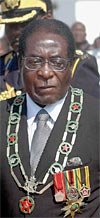
PROFESSOR ROBERT MUGABE (THABO MBEKI"S HERO!)

PROFESSOR ROBERT MUGABE (THABO MBEKI"S HERO!)
"Degrees in violence!"

HIS EXCELLENCY THE PRESIDENT OF ZIMBABWE!

HIS EXCELLENCY THE PRESIDENT OF ZIMBABWE!
President Morgan Tsvangirai!

GRACE KWINJE (AFTER THE ZANU-PF "TSUNAMI")

GRACE KWINJE (AFTER THE ZANU-PF "TSUNAMI")
"Nothing more to add, Your Worship!"

WELCOME TO THE LAND OF THE ONE-PARTY STATE!

WELCOME TO THE LAND OF THE ONE-PARTY STATE!
"MANY BELIEVE THE NON-VIOLENT STANCE MUST BE REVIEWED!"

"THE MUGABE WAY!" MUGABE IS THE PROFESSOR OF VIOLENCE!

"THE MUGABE WAY!" MUGABE IS THE PROFESSOR OF VIOLENCE!
SO MUGABE IS SMILING....IS HE?" What gives him the confidence to cross the line so freely? Is it Mbeki?

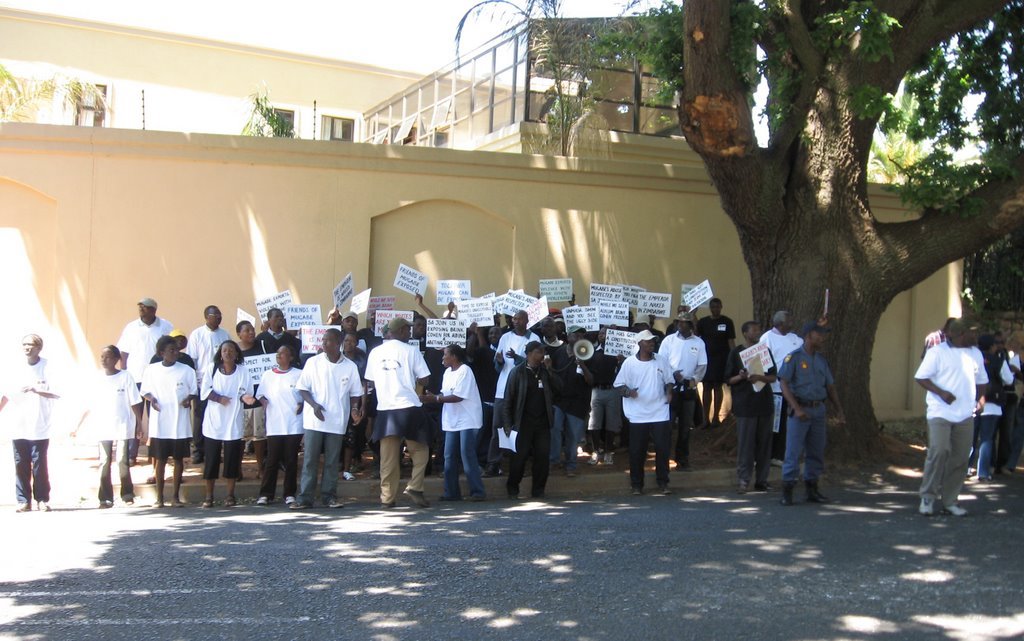
These are Zimbabweans demonstrating in J"burg! (refer www.fozc.blogspot.com)

These are Zimbabweans demonstrating in J"burg! (refer www.fozc.blogspot.com)
"We need to engage COSATU to add weight to our efforts!"
GoStats hit counter
GoStats hit counter